It starts with good intentions, and maybe a Slack message from someone in Facilities. "What if we just bought a few bikes for employees to borrow?" The idea spreads. HR loves it. Sustainability loves it. Leadership approves a small budget. Twenty bikes are ordered, a storage closet is cleared out, and the program is born.
We've heard this story dozens of times from prospective customers, and here's what almost always happens next: the program quietly stalls. The bikes collect dust. Someone files a maintenance request. A bike goes missing. Demand outpaces the supply, or worse; the bikes sit untouched because no one wanted that specific model.
A company bike lending library is a genuinely well-intentioned first step. But there's a reason why the programs that drive real behavior change look less like a closet full of shared bikes and more like a fully managed employee benefit. Let's break down exactly why, and what you can do about it.
Twenty bikes seems like a lot when you're ordering them. In practice, it's an invisible ceiling. Here's what creates it:
When a company orders bikes for a shared fleet, they typically pick one or two models and bulk-order them. It's a logical plan that provides volume discounts, easier to manage inventory, and simpler procurement processes. The problem? Employees aren't one-size-fits-all. The employee who lives 2 miles away on flat roads wants something different than the one who lives 7 miles away with a hill or two in between. The person who wants to drop their child off on their way to work needs cargo capacity. The employee who hasn't been on a bike in ten years needs something stable and confidence-inspiring.
When the fleet doesn't match what employees actually want, utilization plummets. You've spent thousands of dollars on bikes that sit unused, not because employees don't want to commute by bike, but because those bikes aren't right for them.
There's a well-documented phenomenon in shared asset programs: when no one owns something, everyone is a little less careful with it. A company bike is no one's bike. Seats get left in the wrong position. Minor maintenance issues go unreported. A flat tire that would take a personal bike owner 20 minutes to fix can keep a shared bike out of rotation for weeks because no one knows whose job it is to fix it.
A 2024 peer-reviewed study published in the International Journal of Research in Marketing put hard numbers on exactly how much this matters. Researchers surveyed actual Uber and Lyft drivers and compared them to car owners who don't share their vehicles with the public. After controlling for mileage, vehicle age, and purchase price, ride-share drivers planned to replace their cars in just 42 months on average. Non-sharing owners planned to keep theirs for 63 months. That's a 33% shorter lifespan, driven by what researchers call a loss of "psychological ownership", the feeling that something is genuinely yours.
Critically, the researchers ruled out wear and tear as the explanation. The effect held even after accounting for how many miles the vehicle had been driven. It wasn't heavy use that made people value their asset less, it was the act of sharing it. A follow-up experiment confirmed this using CouchSurfing hosts, who share their couches for free with no financial incentive. Same result: people sharing their assets with others planned to replace them nearly two years sooner than those who kept them to themselves.
There's a painful irony here for companies running bike libraries. Shared programs are supposed to maximize resource utilization.. But the research suggests the opposite may be true in practice: shared assets get devalued and replaced faster precisely because no one feels enough ownership to maintain them. For companies that launched a bike library specifically to hit ESG targets or reduce their Scope 3 emissions footprint, this is a direct contradiction of the program's core purpose. More bikes cycling through replacement means more manufacturing, more waste, and ultimately a larger carbon footprint than the one you were trying to shrink.
After a few months, your fleet of 20 bikes is actually a fleet of 14 rideable bikes, and declining. The program that started strong starts to feel like a liability.
Who fixes a flat? Who tightens the brakes when they get spongy? Who replaces a chain that's stretched past its limit? In a corporate bike library, the answer is usually: nobody, until there's a crisis. Most companies don't have an in-house bike mechanic. Local bike shops can have multi-week backlogs. The result is a growing number of out-of-service bikes, and employees who try to borrow one only to find it's not in rideable condition.
High quality e-bikes cost real money. A commuter e-bike from a brand like Specialized or Trek runs $3,000–$4,000 or more. When one gets stolen, that's a significant, expensive loss. And beyond theft, what happens if an employee gets hurt riding a company-owned bike? Who's insured? Who's liable? These questions often don't get answered until something goes wrong, and by then, it's too late.
Storage adds another layer of complexity. Where do 20 bikes live when not in use? A dedicated, secure, accessible bike storage room isn't a given in most office buildings. Bikes end up in conference rooms, hallways, and parking garages, and the program starts to feel like more trouble than it's worth.
Let's say the program actually works. Demand increases. Employees want more bikes. Now what? You have to make another capital purchase, solve the same inventory/selection problem at higher volume, figure out more storage space, and build more operational infrastructure to manage the fleet. Every bike you add compounds the complexity. Most organizations quietly decide that 20 bikes is the limit, not because that's the right answer, but because scaling further is just too painful.
Here's where the math gets revealing. Companies considering a bike lending library tend to think of it as a low-cost initiative. But when you run the numbers, the per-employee economics are often worse than a fully managed subscription, and the outcomes are far less certain.
Let's use a real example. A quality commuter e-bike costs approximately $3,500 (example: Specialized Turbo Vado). That price gets you:
Now consider what that same $3,500 buys with Ridepanda's month-to-month subscription model. At an average subscription price of $137 per employee per month, that same $3,500 could get 2 employees on their own Ridepanda bikes for a full year, each choosing the right vehicle for their use-case from a curated catalog, with theft coverage, maintenance, onboarding, a helmet, and a lock all included. For the price of one shared bike that employees take turns borrowing, two people can have their own personal subscription and use the bike for commuting, running errands, or however else they see fit. This is where real behavior change can happen.
Zoom out to the full fleet: a 20-bike library at $3,500 per bike represents a $70,000 capital commitment. That same budget, directed toward Ridepanda, would put 42 employees on their own bikes for an entire year.
And here's what makes the math even more favorable: Ridepanda is entirely utilization-based. Employers only pay for employees who are actively subscribed to a vehicle. If your program launches with 20 riders in month one, you're only paying for those 20 riders. You're not underwriting a fleet of 20 bikes sitting in storage waiting to be claimed. There's no sunk cost, no depreciation, no budget locked up in assets that may never get used. Every dollar spent is a dollar that went toward an employee actually riding.
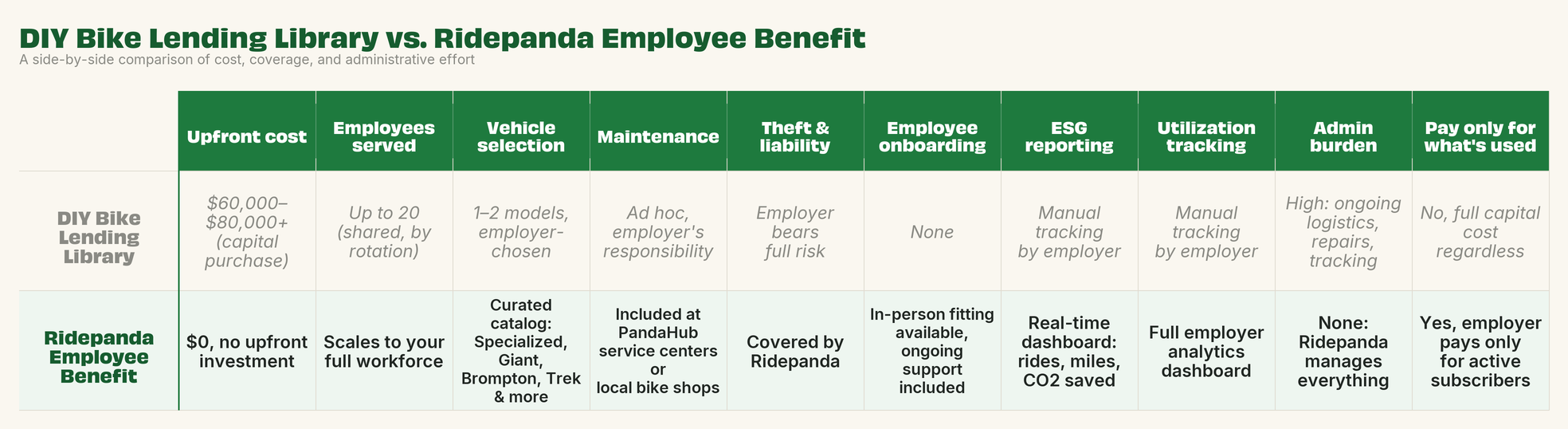
Here's the thing that rarely gets discussed in the bike library conversation: even if all 20 bikes were in perfect condition, fully utilized, and perfectly matched to employee needs, the model still wouldn't produce the lasting commute transformation that most of these programs are started to create.
Behavior change requires ownership. Not necessarily legal ownership of the asset, but the psychological ownership that comes with having your bike; the one that's fitted to your body, that waits for you at home, and that you bring in for a tune-up or swap for a different model if it's not working for you. That's what drives habitual cycling.
Our data tells this story clearly: 74% of Ridepanda riders never or rarely commuted by bike before joining the program. After joining, 84% commute several times a week. That's because every rider has their own vehicle that they selected specifically for their needs. It's available whenever they want to ride, and it's in the condition they left it. They also have a clear process for support and maintenance, and they know who to contact in the case of theft.
A shared bike library can't produce that. You can't develop a real riding habit around a bike you share with fifteen coworkers and have to reserve in advance. You can't become a habitual cyclist when the bike might not be available the morning you're feeling extra motivated to ride to work.
When a company launches with Ridepanda, here's what happens. The program goes live in a matter of weeks. Employees get access to a custom-branded portal where they can browse a curated catalog of e-bikes, pedal bikes, and e-scooters from brands like Specialized, Giant, Brompton, and Trek. They choose the bike that fits their commute, their body, and their style.
Depending on where they are located, they could come to a PandaHub, where a Ridepanda expert fits them on their bike, hands them a helmet and lock, shares local route tips, and answers every question they have.
Maintenance? Handled. Theft coverage? Included. If the bike isn't the right fit after a few weeks, they swap it. If something breaks, they bring it into a PandaHub, or any local bike shop, and Ridepanda reimburses them. Employers get a real-time analytics dashboard showing rides, miles, and emissions saved, the data that sustainability and HR teams need for reporting.
And here's the part that employers love most: they only pay for what employees actually use. No capital locked up in 20 bikes that might or might not get ridden.
If your company has tried a bike lending program, or is thinking about starting one, that instinct is worth celebrating. It means you know that e-bikes can transform the commute, reduce emissions, and make coming to the office something employees actually look forward to.
The bike library is a starting line. It proves internal appetite and tests the concept. But the companies that go further, and see 10–15% e-bike adoption rates among employees and measurable Scope 3 emissions reductions, are the ones who graduated from a shared fleet to a fully managed program.
Because at the end of the day, your employees don't just need access to a bike. They need their own bike. The one that's waiting at home, fitted to them, maintained, covered, and ready to make their commute the best part of their day.
By submitting this form you agree to receive communications by text message about my inquiry.
You may opt-out by replying STOP or ask for more information by replying HELP. Message frequency varies. Message and data rates may apply. You may review our Privacy Policy to learn how your data is used.
