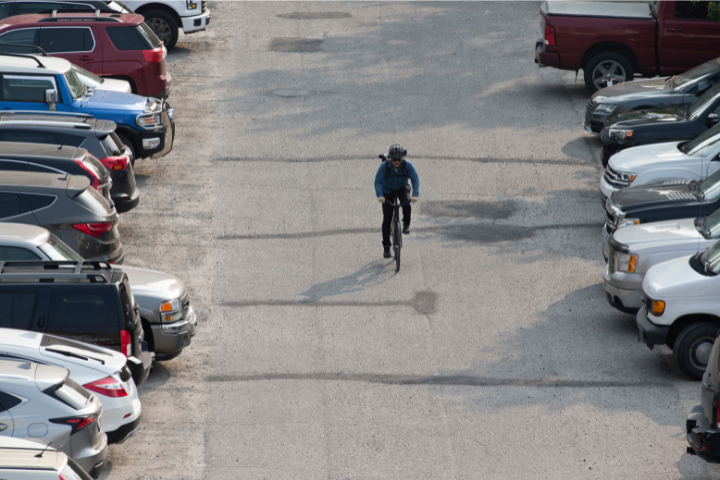
A practical guide on how to redirect parking spend into commute benefits that reduce costs, cut emissions, and actually work.
Companies across the country are bringing employees back to the office. The mandates are real, the expectations are rising, and the offices are ready. But there's a problem no one put in the RTO memo: the parking lot.
But the future of the employer commute program is being decided right now by the companies willing to look honestly at what their parking budget is actually buying.
It's buying a single behavior, at enormous cost, that most employers say they want less of. It's creating a waitlist where there should be a welcome mat. It's writing a check every month that never shows up as an employee benefit in any survey, never earns a single ESG point, and never helps anyone feel better about their commute or their job. And the employer ends up in the same place: subsidizing a commute behavior that's expensive, counterproductive to sustainability goals, and deeply unfair to the employees who don't drive.
The alternative is already working at companies like Amazon, Google, and a fast-growing AI company in San Francisco that ran out of spots and found something better. The math closes quickly. These companies are making parking matter less by redirecting the money currently spent on parking subsidies toward benefits that actually change how employees get to work. The behavior change is real. The employees who make the switch don't miss the parking spot.
They're too busy looking forward to the ride.
The cost of employer-subsidized parking is almost always underestimated, because it rarely shows up in a benefits budget. It lives in real estate, in facilities, in lease terms negotiated years ago. But the numbers are significant.
In San Francisco, commercial monthly parking runs $400–$530+ per space per month, or $4,800 to $6,360 per year, per spot. In New York, Seattle, Boston, and Washington D.C., the figures are comparable. Even in mid-tier markets, employer-subsidized parking routinely costs $150–$300 per space per month once infrastructure and management overhead are factored in.
The tax treatment makes it worse. According to research from the Victoria Transport Policy Institute, a typical employee must earn $2,000 or more in pre-tax income to pay for a parking space that costs their employer $1,000 to provide. Employers absorb the gap and rarely see it.
For a company providing 200 subsidized parking spaces in a major city, that's $960,000 to over $1.2 million per year in parking benefit: an invisible line item in the total compensation conversation, and one of the largest untaxed benefits most companies offer. Almost none of it shows up on an employee's W-2. Almost none of it appears in an ESG report. And almost all of it is paying employees to do exactly what most companies say they want to reduce: driving to work alone.
The intuition behind offering free parking to support RTO is understandable: make it easy for employees to come in. But the data tells a different story.
According to a 2023 U.S. Department of Transportation analysis, 95% of American commuters receive free workplace parking, while only 9% have access to any transit subsidy. Studies consistently find that when employers begin charging for parking, or offer employees the cash equivalent of their parking spot, drive-alone commute rates fall by 12–13 percent. Free parking doesn't just reward driving; it crowds out every alternative. When the parking spot is free, the bus, the bike, and the train all have to compete against zero.
There's also what transportation experts call the monthly pass trap. When an employer provides a monthly parking pass, employees feel compelled to drive every day to "get their money's worth." Each day they take the bus or bike feels like a loss. Alternatively, If you charge daily, there's always an incremental cost and commuters no longer feel the need to get the most value out of their monthly pass.
The resulting dynamic is one where free parking doesn't just cost money; it actively suppresses the alternative commute behaviors employers increasingly want to encourage. It makes RTO feel like a mandate to drive, rather than an invitation to come in however works best.
And for the employees who don't or can't drive? They watch the parking benefit go to colleagues while receiving nothing comparable. Parking subsidies are one of the most regressive benefits in the modern workplace: they only help people who own cars and choose to drive.
The good news is that the fix doesn't require a massive budget, a new vendor relationship, or a mandate. It requires a different way of thinking about what parking money is for, along with a few straightforward operational changes.
This is the single most powerful commute behavior change tool available to employers. It costs nothing to implement. Simply stop selling monthly parking passes and start charging by the day.
The data on this is striking. When the Bill & Melinda Gates Foundation moved into its new Seattle headquarters, the city required it to stop offering free parking. The Foundation introduced a $12-per-day charge (capped at $120/month) and simultaneously began paying employees $3 per day for any alternative commute: transit, biking, walking, or carpooling. The result: the drive-alone rate dropped from approximately 90% to 34%. On a typical day, fewer than half of the Foundation's 700+ parking spaces are used.
Delta Dental of Washington saw similar results when it moved offices and introduced $15-per-day parking. Its drive-alone rate fell from roughly 75% to 16% within two months, and more than half of its 80 parking spaces now sit empty on a typical workday.
The mechanism is simple: a monthly pass makes every drive after the first "free." A daily charge makes every drive a real-time choice. That choice, made morning by morning, is where behavior change happens.
Action: If you're still offering monthly parking passes, convert to daily billing at market rate, capped at the monthly equivalent. This step alone routinely reduces drive-alone rates by 30–50 percentage points. Implementation cost: zero.
The second move is to take a portion of what you're currently spending on parking and offer it directly to employees who choose not to use a parking spot. This is called a parking cash-out program. The research behind it is consistent and compelling.
Economist Donald Shoup's landmark research found that total vehicle trips declined by 17% after parking cash-out was introduced at various urban and suburban worksites. Drive-alone rates fell by 41% in five Bay Area locations analyzed when employees had to pay to park. The math is straightforward: when not driving has real monetary value, more people find ways not to drive.
The employer examples are equally concrete. Engineering firm CH2M Hill, upon moving into new offices in Bellevue, Washington, offered employees a choice: free parking if they drove alone, or they would be paid $40 per month (~$480/year) if they walked, biked, carpooled, or took transit. The drive-alone rate fell from 89% to 54%. The share of employees biking or walking to work jumped from 1% to 17%.
Regional transportation programs are institutionalizing the same principle at scale:
These programs exist because the evidence is clear: putting real money behind the choice not to drive produces real results. Employers can replicate the same logic internally; the infrastructure already exists.
Action: Calculate your current per-space monthly parking cost. Offer employees who voluntarily give up their spot a cash-out equal to 50–100% of that value as a commuter stipend to use for alternate methods (like e-bikes!). The savings from unused spaces will more than offset the incentive payments.
Here's what this looks like with real figures for a mid-sized San Francisco employer.
The starting point: A company provides 200 subsidized parking spaces in a San Francisco garage at the market rate of $450/month per space, a conservative mid-range figure for the city. Total annual parking spend: $1,080,000.
The program: The company announces a voluntary cash-out. Any employee who gives up their assigned parking spot receives $225/month (50% of the space value) as a commuter stipend, usable toward transit, an e-bike subscription, or any other commute alternative. No one is forced to give up their spot.
The result: Based on outcomes documented across comparable employer programs, roughly 35% of employees take the offer. In this scenario, that's 70 employees.
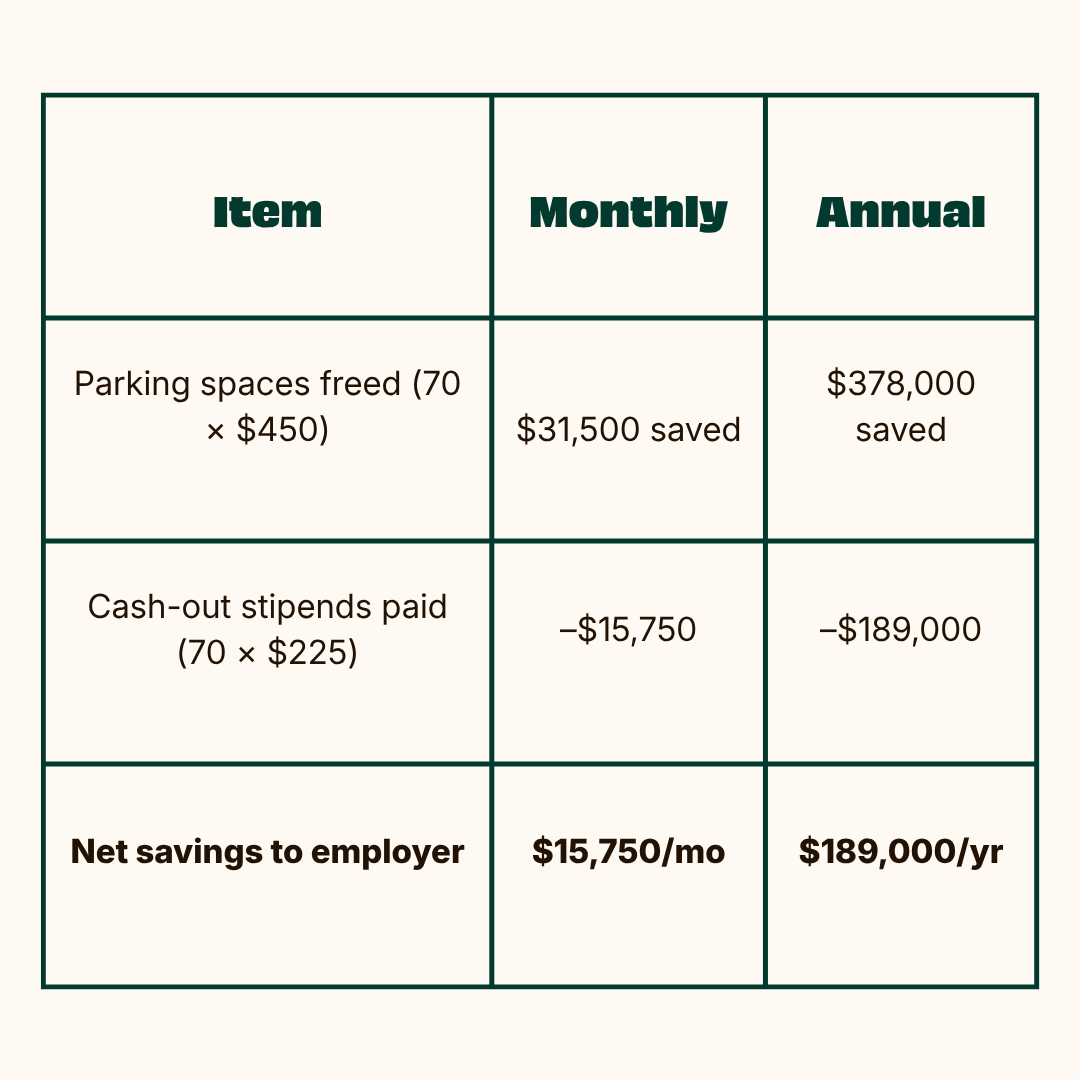
The math improves further if the stipend is directed toward a structured benefit rather than a flat cash payment. If the company redirects that $225/month per employee toward a Ridepanda e-bike subscription at $99/month, fully subsidized, the employer could end up keeping the remaining $126/month per converted employee as additional net savings. That's $294,840 back per year, while 70 employees are now riding to work instead of driving.
The 130 employees who kept their spots still have them. Nobody was penalized. And the company is now spending $294,840 less per year on commute benefits, while the employees who made the switch are, by every measure, happier about their commute than they were before.
The third move, and perhaps the most elegant, is to use revenue from parking charges to fund the commute programs that reduce parking demand in the first place.
When you charge employees for parking, you generate revenue. That revenue can fund transit subsidies, e-bike subscriptions, guaranteed ride home programs, or bike storage infrastructure.
The model is budget-neutral by design. Stop subsidizing parking. Start subsidizing alternatives. The net cost can be zero, or in many cases significantly negative, because the alternatives are dramatically cheaper than what you were spending on parking.
This is where the numbers become genuinely surprising, even to finance leaders who've seen the parking budget before.
A Ridepanda e-bike subscription starts at $99/month. A scooter starts at $49/month. Each subscription includes the vehicle, maintenance, theft insurance, a helmet, a lock, and full customer service support. The employer subsidy required is minimal, because the subscription already includes everything an employee needs, with no hidden costs and no repair bills.
Compare that to a subsidized parking space in a major city:

One employee switching from a subsidized San Francisco parking spot (~$450/month) to a Ridepanda e-bike subscription ($99/month) saves the employer $351/month ($4,212/year) per converted employee.
For 50 employees making the switch: approximately $210,000/year in recaptured parking spend. Enough to fund the e-bike program for the entire company, and still come out significantly ahead.
And unlike the parking spot, which sits empty on WFH days, creates waitlist politics, and never appears in an ESG report, the e-bike benefit goes home with the employee. It gets used on weekends. It carries kids to daycare. It becomes part of a life, not just a line item.
Action: Start a pilot program with Ridepanda, offering a $100 subsidy for the first 50 riders who sign up. At a maximum you will be paying $5,000 per month, and with these first 50 riders you can collect feedback and show leadership all of the benefits employees get when they switch from car commuting to e-bike or scooter commuting.
This is the question every HR leader asks. The answer, consistently and across thousands of riders, is: Yes! And they ride more than anyone expects.
74% of Ridepanda riders had never regularly commuted by bike before joining the program. After joining, 84% commute several times per week by bike or scooter. The average Ridepanda rider takes 6 fewer car trips per week. For context: that's the same person who, a few months earlier, was in the parking waitlist queue.
The behavior change data from Amazon's program, deployed across 65+ U.S. offices, is equally striking. 85% of Amazon Ridepanda riders had limited or no experience commuting by bicycle before joining. After joining, 42% now commute daily by e-bike or scooter. The drive-alone parking impact is direct and measurable: 36% of riders replaced 2–4 solo car trips per week; 29% replaced 6–8.
The wellness data reinforces the case. 80% of Ridepanda riders report feeling more energized and less stressed after commuting on their vehicle. 66% say it has improved their mental and physical health. 39% say the program increased their satisfaction with their employer.
The parking spot doesn't do any of that.
One of Ridepanda's partners is a leading technology company headquartered in San Francisco. Leadership faced a problem that money alone couldn't solve: there were not enough parking spaces for the growing team, and, in a dense urban core with no adjacent land available, there was no way to add more.
Existing parking spots were expensive, demand exceeded supply, and the allocation of limited spaces was quietly becoming a source of friction. The question wasn't "how do we add more parking?" It was "how do we make parking matter less?"
The company partnered with Ridepanda to offer employees a subsidized e-bike and scooter subscription as a commute benefit. No one was required to give up their parking spot. The goal was simply to make the alternative compelling enough that employees would choose it.
The program became one of the most talked-about employee benefits in the company. Parking pressure meaningfully decreased. And for employees who made the switch, the commute through San Francisco became something they actually looked forward to.
Within six months of launch, 15% of the company's employees had subscribed to Ridepanda. That’s more than seven times the national average cycling commute rate of roughly 2%. The program didn't require a mandate, a parking policy change, or a new benefits budget. It required making the alternative genuinely better than the status quo.
The lesson generalizes. When you can't solve the parking problem with more parking, you solve it by making parking less necessary. And the companies getting this right aren't fighting over spots, they're offering employees something better than a spot.
You don't need to overhaul your entire commute program at once. The most successful employers start with one or two moves and build from there.
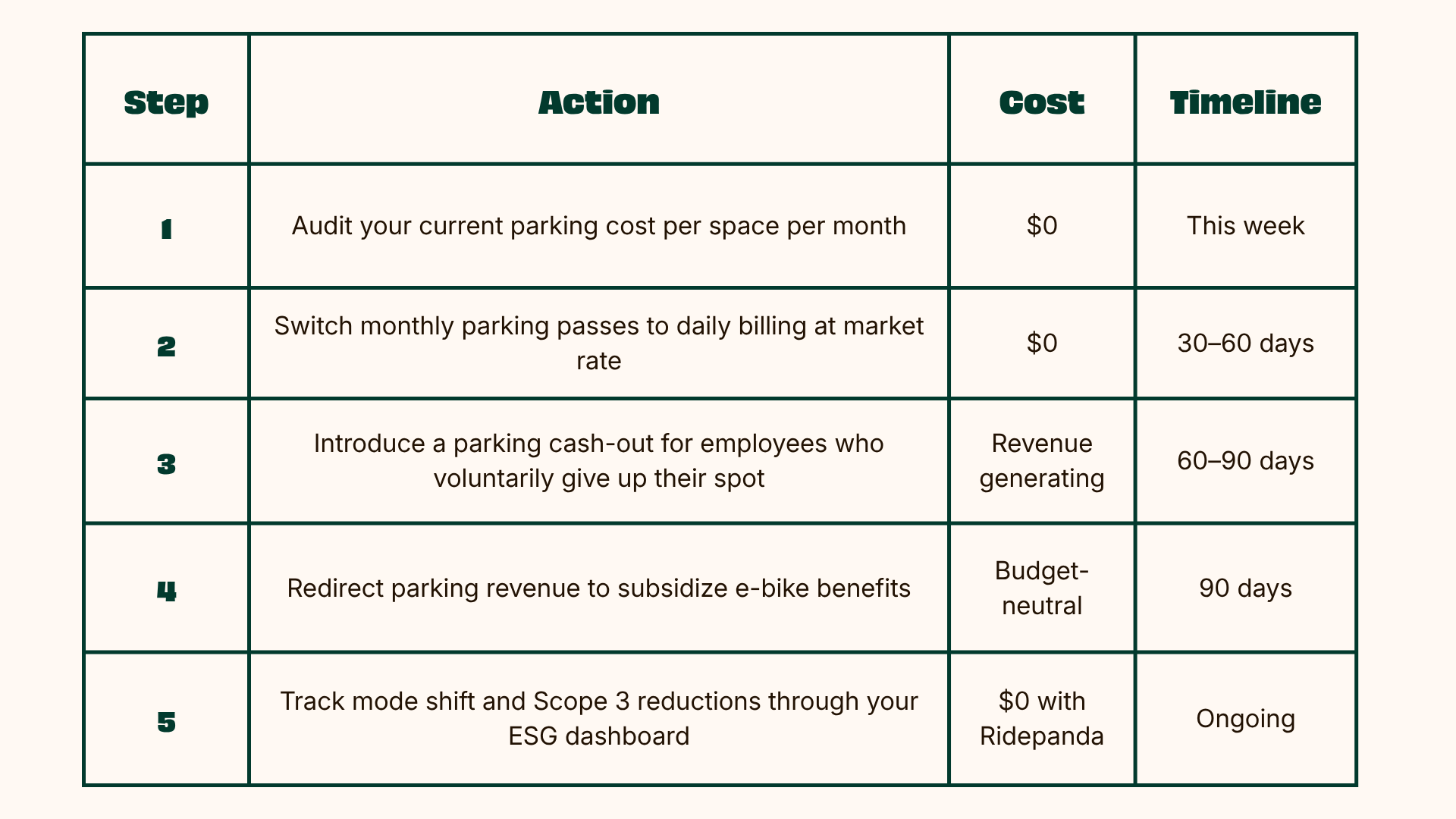
The full transformation doesn't happen overnight. But the first two steps, auditing your parking cost and switching to daily billing, are available to every employer, in every market, starting now. The rest follows naturally, because once employees have a daily choice about how they commute, a meaningful percentage will choose differently. And when they do, the savings fund the next step.
Ridepanda works with employers to design commute programs that reduce parking demand, improve employee wellness, and generate the ESG data your sustainability team actually needs. The program goes live in weeks, requires no new budget, and comes with everything employees need to make the switch; the vehicle, the maintenance, the insurance, the helmet, and the support.
If you're ready to rethink what your parking budget could buy, we'd love to show you the math.
By submitting this form you agree to receive communications by text message about my inquiry.
You may opt-out by replying STOP or ask for more information by replying HELP. Message frequency varies. Message and data rates may apply. You may review our Privacy Policy to learn how your data is used.
